Sunday, April 01, 2007

Easter

The Empty Tomb, Brother Sylvain, Taize

Luke 24:1-10

On the first day of the week, at early dawn, the women who had come with Jesus from Galilee came to the tomb, taking the spices that they had prepared. They found the stone rolled away from the tomb, but when they went in, they did not find the body. While they were perplexed about this, suddenly two men in dazzling clothes stood beside them. The women were terrified and bowed their faces to the ground, but the men said to them, "Why do you look for the living among the dead? He is not here, but has risen. Remember how he told you, while he was still in Galilee, that the Son of Man must be handed over to sinners, and be crucified, and on the third day rise again." Then they remembered his words, and returning from the tomb, they told all this to the eleven and to all the rest. Now it was Mary Magdalene, Joanna, Mary the mother of James, and the other women with them who told this to the apostles.

Monday, March 26, 2007

Palm Sunday

Palm Sunday St. Johns, Karen A. Jerome

Luke 23.1-49

Then the assembly rose as a body and brought Jesus before Pilate. They began to accuse him, saying, "We found this man perverting our nation, forbidding us to pay taxes to the emperor, and saying that he himself is the Messiah, a king." Then Pilate asked him, "Are you the king of the Jews?" He answered, "You say so." Then Pilate said to the chief priests and the crowds, "I find no basis for an accusation against this man." But they were insistent and said, "He stirs up the people by teaching throughout all Judea, from Galilee where he began even to this place."

When Pilate heard this, he asked whether the man was a Galilean. And when he learned that he was under Herod's jurisdiction, he sent him off to Herod, who was himself in Jerusalem at that time. When Herod saw Jesus, he was very glad, for he had been wanting to see him for a long time, because he had heard about him and was hoping to see him perform some sign. He questioned him at some length, but Jesus gave him no answer. The chief priests and the scribes stood by, vehemently accusing him. Even Herod with his soldiers treated him with contempt and mocked him; then he put an elegant robe on him, and sent him back to Pilate. That same day Herod and Pilate became friends with each other; before this they had been enemies.

Pilate then called together the chief priests, the leaders, and the people, and said to them, "You brought me this man as one who was perverting the people; and here I have examined him in your presence and have not found this man guilty of any of your charges against him. Neither has Herod, for he sent him back to us. Indeed, he has done nothing to deserve death. I will therefore have him flogged and release him."

Then they all shouted out together, "Away with this fellow! Release Barabbas for us!" (This was a man who had been put in prison for an insurrection that had taken place in the city, and for murder.) Pilate, wanting to release Jesus, addressed them again; but they kept shouting, "Crucify, crucify him!" A third time he said to them, "Why, what evil has he done? I have found in him no ground for the sentence of death; I will therefore have him flogged and then release him." But they kept urgently demanding with loud shouts that he should be crucified; and their voices prevailed. So Pilate gave his verdict that their demand should be granted. He released the man they asked for, the one who had been put in prison for insurrection and murder, and he handed Jesus over as they wished.

As they led him away, they seized a man, Simon of Cyrene, who was coming from the country, and they laid the cross on him, and made him carry it behind Jesus. A great number of the people followed him, and among them were women who were beating their breasts and wailing for him. But Jesus turned to them and said, "Daughters of Jerusalem, do not weep for me, but weep for yourselves and for your children. For the days are surely coming when they will say, 'Blessed are the barren, and the wombs that never bore, and the breasts that never nursed.' Then they will begin to say to the mountains, 'Fall on us'; and to the hills, 'Cover us.' For if they do this when the wood is green, what will happen when it is dry?"

Two others also, who were criminals, were led away to be put to death with him. When they came to the place that is called The Skull, they crucified Jesus there with the criminals, one on his right and one on his left. Then Jesus said, "Father, forgive them; for they do not know what they are doing." And they cast lots to divide his clothing. And the people stood by, watching; but the leaders scoffed at him, saying, "He saved others; let him save himself if he is the Messiah of God, his chosen one!" The soldiers also mocked him, coming up and offering him sour wine, and saying, "If you are the King of the Jews, save yourself!" There was also an inscription over him, "This is the King of the Jews."

One of the criminals who were hanged there kept deriding him and saying, "Are you not the Messiah? Save yourself and us!" But the other rebuked him, saying, "Do you not fear God, since you are under the same sentence of condemnation? And we indeed have been condemned justly, for we are getting what we deserve for our deeds, but this man has done nothing wrong." Then he said, "Jesus, remember me when you come into your kingdom." He replied, "Truly I tell you, today you will be with me in Paradise."

It was now about noon, and darkness came over the whole land until three in the afternoon, while the sun's light failed; and the curtain of the temple was torn in two. Then Jesus, crying with a loud voice, said, "Father, into your hands I commend my spirit." Having said this, he breathed his last. When the centurion saw what had taken place, he praised God and said, "Certainly this man was innocent." And when all the crowds who had gathered there for this spectacle saw what had taken place, they returned home, beating their breasts. But all his acquaintances, including the women who had followed him from Galilee, stood at a distance, watching these things.

Sunday, March 18, 2007

5 Lent

Parable of the Vineyard, 15th C (Germany?), National Library of the Netherlands

Luke 20:9-19

Jesus began to tell the people this parable: "A man planted a vineyard, and leased it to tenants, and went to another country for a long time. When the season came, he sent a slave to the tenants in order that they might give him his share of the produce of the vineyard; but the tenants beat him and sent him away empty-handed. Next he sent another slave; that one also they beat and insulted and sent away empty-handed. And he sent still a third; this one also they wounded and threw out. Then the owner of the vineyard said, 'What shall I do? I will send my beloved son; perhaps they will respect him.' But when the tenants saw him, they discussed it among themselves and said, 'This is the heir; let us kill him so that the inheritance may be ours.' So they threw him out of the vineyard and killed him. What then will the owner of the vineyard do to them? He will come and destroy those tenants and give the vineyard to others." When they heard this, they said, "Heaven forbid!" But he looked at them and said, "What then does this text mean:

'The stone that the builders rejected
has become the cornerstone'?

Everyone who falls on that stone will be broken to pieces; and it will crush anyone on whom it falls." When the scribes and chief priests realized that he had told this parable against them, they wanted to lay hands on him at that very hour, but they feared the people.

Sunday, March 11, 2007

4 Lent

Luke 15:11-32

The father welcomes his son

Jesus said, "There was a man who had two sons. The younger of them said to his father, 'Father, give me the share of the property that will belong to me.' So he divided his property between them. A few days later the younger son gathered all he had and traveled to a distant country, and there he squandered his property in dissolute living. When he had spent everything, a severe famine took place throughout that country, and he began to be in need. So he went and hired himself out to one of the citizens of that country, who sent him to his fields to feed the pigs. He would gladly have filled himself with the pods that the pigs were eating; and no one gave him anything. But when he came to himself he said, 'How many of my father's hired hands have bread enough and to spare, but here I am dying of hunger! I will get up and go to my father, and I will say to him, "Father, I have sinned against heaven and before you; I am no longer worthy to be called your son; treat me like one of your hired hands."' So he set off and went to his father. But while he was still far off, his father saw him and was filled with compassion; he ran and put his arms around him and kissed him. Then the son said to him, 'Father, I have sinned against heaven and before you; I am no longer worthy to be called your son.' But the father said to his slaves, 'Quickly, bring out a robe--the best one--and put it on him; put a ring on his finger and sandals on his feet. And get the fatted calf and kill it, and let us eat and celebrate; for this son of mine was dead and is alive again; he was lost and is found!' And they began to celebrate.

"Now his elder son was in the field; and when he came and approached the house, he heard music and dancing. He called one of the slaves and asked what was going on. He replied, 'Your brother has come, and your father has killed the fatted calf, because he has got him back safe and sound.' Then he became angry and refused to go in. His father came out and began to plead with him. But he answered his father, 'Listen! For all these years I have been working like a slave for you, and I have never disobeyed your command; yet you have never given me even a young goat so that I might celebrate with my friends. But when this son of yours came back, who has devoured your property with prostitutes, you killed the fatted calf for him!' Then the father said to him, 'Son, you are always with me, and all that is mine is yours. But we had to celebrate and rejoice, because this brother of yours was dead and has come to life; he was lost and has been found.'"

Sunday, March 04, 2007

3 Lent

At one level, God sounds pretty mad. How do you read it?

Jacob Under the Fig Tree, Vatican Library

Luke 13:1-9

There were some present who told Jesus about the Galileans whose blood Pilate had mingled with their sacrifices. He asked them, "Do you think that because these Galileans suffered in this way they were worse sinners than all other Galileans? No, I tell you; but unless you repent, you will all perish as they did. Or those eighteen who were killed when the tower of Siloam fell on them--do you think that they were worse offenders than all the others living in Jerusalem? No, I tell you; but unless you repent, you will all perish just as they did."

Then he told this parable: "A man had a fig tree planted in his vineyard; and he came looking for fruit on it and found none. So he said to the gardener, 'See here! For three years I have come looking for fruit on this fig tree, and still I find none. Cut it down! Why should it be wasting the soil?' He replied, 'Sir, let it alone for one more year, until I dig around it and put manure on it. If it bears fruit next year, well and good; but if not, you can cut it down.'"


Monday, February 26, 2007

2 Lent

Doing justice and loving kindness draw Jesus to Jerusalem. He passed his test in the desert. Now he's on the Way.


Mosaic on the Altar in Dominus Flevit Church on the Mt of Olives. Dominus Flevit translates as the 'the Lord's Cry.'

Luke 13:(22-30)31-35

Some Pharisees came and said to Jesus, "Get away from here, for Herod wants to kill you." He said to them, "Go and tell that fox for me, 'Listen, I am casting out demons and performing cures today and tomorrow, and on the third day I finish my work. Yet today, tomorrow, and the next day I must be on my way, because it is impossible for a prophet to be killed outside of Jerusalem.' Jerusalem, Jerusalem, the city that kills the prophets and stones those who are sent to it! How often have I desired to gather your children together as a hen gathers her brood under her wings, and you were not willing! See, your house is left to you. And I tell you, you will not see me until the time comes when you say, 'Blessed is the one who comes in the name of the Lord.'"

Sunday, February 18, 2007

1 Lent

In December we often hear, What do you want for Christmas? How do we answer the question, What do you want for Lent?

Luke 4:1-13

Jesus, full of the Holy Spirit, returned from the Jordan and was led by the Spirit in the wilderness, where for forty days he was tempted by the devil. He ate nothing at all during those days, and when they were over, he was famished. The devil said to him, "If you are the Son of God, command this stone to become a loaf of bread." Jesus answered him, "It is written, 'One does not live by bread alone.'"

Then the devil led him up and showed him in an instant all the kingdoms of the world. And the devil said to him, "To you I will give their glory and all this authority; for it has been given over to me, and I give it to anyone I please. If you, then, will worship me, it will all be yours." Jesus answered him, "It is written,

'Worship the Lord your God,
and serve only him.'"

Then the devil took him to Jerusalem, and placed him on the pinnacle of the temple, saying to him, "If you are the Son of God, throw yourself down from here, for it is written,

'He will command his angels concerning you,
to protect you,'

and

'On their hands they will bear you up,
so that you will not dash your foot against a stone.'"

Jesus answered him, "It is said, 'Do not put the Lord your God to the test.'" When the devil had finished every test, he departed from him until an opportune time.

Sunday, February 11, 2007

Last Epiphany

Transfiguration - a change in form or appearance; metamorphosis, an exalting, glorifying, spiritual change. Thoughts?

Luke 9:28-36, [37-43a]

About eight days after Peter had acknowledged Jesus as the Christ of God, Jesus took with him Peter and John and James, and went up on the mountain to pray. And while he was praying, the appearance of his face changed, and his clothes became dazzling white. Suddenly they saw two men, Moses and Elijah, talking to him. They appeared in glory and were speaking of his departure, which he was about to accomplish at Jerusalem. Now Peter and his companions were weighed down with sleep; but since they had stayed awake, they saw his glory and the two men who stood with him. Just as they were leaving him, Peter said to Jesus, "Master, it is good for us to be here; let us make three dwellings, one for you, one for Moses, and one for Elijah"--not knowing what he said. While he was saying this, a cloud came and overshadowed them; and they were terrified as they entered the cloud. Then from the cloud came a voice that said, "This is my Son, my Chosen; listen to him!" When the voice had spoken, Jesus was found alone. And they kept silent and in those days told no one any of the things they had seen.

On the next day, when they had come down from the mountain, a great crowd met him. Just then a man from the crowd shouted, "Teacher, I beg you to look at my son; he is my only child. Suddenly a spirit seizes him, and all at once he shrieks. It convulses him until he foams at the mouth; it mauls him and will scarcely leave him. I begged your disciples to cast it out, but they could not." Jesus answered, "You faithless and perverse generation, how much longer must I be with you and bear with you? Bring your son here." While he was coming, the demon dashed him to the ground in convulsions. But Jesus rebuked the unclean spirit, healed the boy, and gave him back to his father. And all were astounded at the greatness of God.

Sunday, January 28, 2007

6 Epiphany

It occurs to me lately that I'm usually on the 'cursed' side of this ledger. How about you? What does it say to us?

Luke 6:17-26

Jesus came down with the twelve apostles, and stood on a level place, with a great crowd of his disciples and a great multitude of people from all Judea, Jerusalem, and the coast of Tyre and Sidon. They had come to hear him and to be healed of their diseases; and those who were troubled with unclean spirits were cured. And all in the crowd were trying to touch him, for power came out from him and healed all of them.

Then he looked up at his disciples and said:
"Blessed are you who are poor,
for yours is the kingdom of God.
"Blessed are you who are hungry now,
for you will be filled.
"Blessed are you who weep now,
for you will laugh.

"Blessed are you when people hate you, and when they exclude you, revile you, and defame you on account of the Son of Man. Rejoice in that day and leap for joy, for surely your reward is great in heaven; for that is what their ancestors did to the prophets.

"But woe to you who are rich,
for you have received your consolation.
"Woe to you who are full now,
for you will be hungry.
"Woe to you who are laughing now,
for you will mourn and weep.

"Woe to you when all speak well of you, for that is what their ancestors did to the false prophets.

5 Epiphany

Got fish?

Luke 5:1-11

Once while Jesus was standing beside the lake of Gennesaret, and the crowd was pressing in on him to hear the word of God, he saw two boats there at the shore of the lake; the fishermen had gone out of them and were washing their nets. He got into one of the boats, the one belonging to Simon, and asked him to put out a little way from the shore. Then he sat down and taught the crowds from the boat. When he had finished speaking, he said to Simon, "Put out into the deep water and let down your nets for a catch." Simon answered, "Master, we have worked all night long but have caught nothing. Yet if you say so, I will let down the nets." When they had done this, they caught so many fish that their nets were beginning to break. So they signaled their partners in the other boat to come and help them. And they came and filled both boats, so that they began to sink. But when Simon Peter saw it, he fell down at Jesus' knees, saying, "Go away from me, Lord, for I am a sinful man!" For he and all who were with him were amazed at the catch of fish that they had taken; and so also were James and John, sons of Zebedee, who were partners with Simon. Then Jesus said to Simon, "Do not be afraid; from now on you will be catching people." When they had brought their boats to shore, they left everything and followed him.

Sunday, January 21, 2007

4 Epiphany

Being unrecognized, not taken as we are, is usually unpleasant, even disorienting--particularly when it's by people who are important to us. What do you make of the social dynamics when Jesus goes home to Nazareth?

Luke 4:21-32

In the synagogue at Nazareth, Jesus read from the book of the prophet Isaiah, and began to say, "Today this scripture has been fulfilled in your hearing." All spoke well of him and were amazed at the gracious words that came from his mouth. They said, "Is not this Joseph's son?" He said to them, "Doubtless you will quote to me this proverb, 'Doctor, cure yourself!' And you will say, 'Do here also in your hometown the things that we have heard you did at Capernaum.'" And he said, "Truly I tell you, no prophet is accepted in the prophet's hometown. But the truth is, there were many widows in Israel in the time of Elijah, when the heaven was shut up three years and six months, and there was a severe famine over all the land; yet Elijah was sent to none of them except to a widow at Zarephath in Sidon. There were also many lepers in Israel in the time of the prophet Elisha, and none of them was cleansed except Naaman the Syrian." When they heard this, all in the synagogue were filled with rage. They got up, drove him out of the town, and led him to the brow of the hill on which their town was built, so that they might hurl him off the cliff. But he passed through the midst of them and went on his way.

He went down to Capernaum, a city in Galilee, and was teaching them on the sabbath. They were astounded at his teaching, because he spoke with authority.

Monday, January 15, 2007

3 Epiphany

Ezra reads the Law, and the people weep. But he tells them it is the joy of the Lord that is their strength. Jesus reads a scroll too--in his home town. And finishes with a remarkable statement.

Nehemiah 8:2-10

Ezra, the priest, brought the law before the assembly, both men and women and all who could hear with understanding. This was on the first day of the seventh month. He read from it facing the square before the Water Gate from early morning until midday, in the presence of the men and the women and those who could understand; and the ears of all the people were attentive to the book of the law. The scribe Ezra stood on a wooden platform that had been made for the purpose; and beside him stood Mattithiah, Shema, Anaiah, Uriah, Hilkiah, and Maaseiah on his right hand; and Pedaiah, Mishael, Malchijah, Hashum, Hash-baddanah, Zechariah, and Meshullam on his left hand. And Ezra opened the book in the sight of all the people, for he was standing above all the people; and when he opened it, all the people stood up. Then Ezra blessed the LORD, the great God, and all the people answered, "Amen, Amen," lifting up their hands. Then they bowed their heads and worshiped the LORD with their faces to the ground. Also Jeshua, Bani, Sherebiah, Jamin, Akkub, Shabbethai, Hodiah, Maaseiah, Kelita, Azariah, Jozabad, Hanan, Pelaiah, the Levites, helped the people to understand the law, while the people remained in their places. So they read from the book, from the law of God, with interpretation. They gave the sense, so that the people understood the reading.

And Nehemiah, who was the governor, and Ezra the priest and scribe, and the Levites who taught the people said to all the people, "This day is holy to the LORD your God; do not mourn or weep." For all the people wept when they heard the words of the law. Then he said to them, "Go your way, eat the fat and drink sweet wine and send portions of them to those for whom nothing is prepared, for this day is holy to our LORD; and do not be grieved, for the joy of the LORD is your strength."

Luke 4:14-21

Jesus, filled with the power of the Spirit, returned to Galilee, and a report about him spread through all the surrounding country. He began to teach in their synagogues and was praised by everyone.

When he came to Nazareth, where he had been brought up, he went to the synagogue on the sabbath day, as was his custom. He stood up to read, and the scroll of the prophet Isaiah was given to him. He unrolled the scroll and found the place where it was written:

'The Spirit of the Lord is upon me,
because he has anointed me
to bring good news to the poor.
He has sent me to proclaim release to the captives
and recovery of sight to the blind,
to let the oppressed go free,
to proclaim the year of the Lord's favor."
And he rolled up the scroll, gave it back to the attendant, and sat down. The eyes of all in the synagogue were fixed on him. Then he began to say to them, "Today this scripture has been fulfilled in your hearing."

Monday, January 08, 2007

2 Epiphany

What stories can you remember about scarcity, hunger, the small and the least facing big odds? Remembering stories like these help prepare us to read this gospel lesson during the season of Epiphany.


The Marriage at Cana, Decani


John 2:1-11

On the third day there was a wedding in Cana of Galilee, and the mother of Jesus was there. Jesus and his disciples had also been invited to the wedding. When the wine gave out, the mother of Jesus said to him, "They have no wine." And Jesus said to her, "Woman, what concern is that to you and to me? My hour has not yet come." His mother said to the servants, "Do whatever he tells you." Now standing there were six stone water jars for the Jewish rites of purification, each holding twenty or thirty gallons. Jesus said to them, "Fill the jars with water." And they filled them up to the brim. He said to them, "Now draw some out, and take it to the chief steward." So they took it. When the steward tasted the water that had become wine, and did not know where it came from (though the servants who had drawn the water knew), the steward called the bridegroom and said to him, "Everyone serves the good wine first, and then the inferior wine after the guests have become drunk. But you have kept the good wine until now." Jesus did this, the first of his signs, in Cana of Galilee, and revealed his glory; and his disciples believed in him.

Tuesday, January 02, 2007

1 Epiphany, Year C

How do we tend to understand baptism--by water or the Holy Spirit? Is what we 'know' helpful? Accurate? How do the two readings below fit with our general understanding?

Fire/Water Dance, Terrence Sherman

Acts 10:34-38

Peter began to speak to Cornelius and his relatives and close friends: "I truly understand that God shows no partiality, but in every nation anyone who fears him and does what is right is acceptable to him. You know the message he sent to the people of Israel, preaching peace by Jesus Christ-- he is Lord of all. That message spread throughout Judea, beginning in Galilee after the baptism that John announced: how God anointed Jesus of Nazareth with the Holy Spirit and with power; how he went about doing good and healing all who were oppressed by the devil, for God was with him.

Luke 3:15-16,21-22

As the people were filled with expectation, and all were questioning in their hearts concerning John, whether he might be the Messiah, John answered all of them by saying, "I baptize you with water; but one who is more powerful than I is coming; I am not worthy to untie the thong of his sandals. He will baptize you with the Holy Spirit and fire."

Now when all the people were baptized, and when Jesus also had been baptized and was praying, the heaven was opened, and the Holy Spirit descended upon him in bodily form like a dove. And a voice came from heaven, "You are my Son, the Beloved; with you I am well pleased."

Monday, December 18, 2006

4 Advent

Elizabeth is pregnant with John, Mary with Jesus. Advent is the season of gestation. Year by year we are reminded that in our way we are God-bearers too.

In those days Mary set out and went with haste to a Judean town in the hill country, where she entered the house of Zechariah and greeted Elizabeth. When Elizabeth heard Mary's greeting, the child leaped in her womb. And Elizabeth was filled with the Holy Spirit and exclaimed with a loud cry, "Blessed are you among women, and blessed is the fruit of your womb. And why has this happened to me, that the mother of my Lord comes to me? For as soon as I heard the sound of your greeting, the child in my womb leaped for joy. And blessed is she who believed that there would be a fulfillment of what was spoken to her by the Lord."


The Visitation of Elizabeth by Mary

And Mary said,

"My soul magnifies the Lord,
and my spirit rejoices in God my Savior,
for he has looked with favor on the lowliness of his servant.
Surely, from now on all generations will call me blessed;
for the Mighty One has done great things for me,
and holy is his name.
[His mercy is for those who fear him
from generation to generation.
He has shown strength with his arm;
he has scattered the proud in the thoughts of their hearts.
He has brought down the powerful from their thrones,
and lifted up the lowly;
he has filled the hungry with good things,
and sent the rich away empty.
He has helped his servant Israel,
in remembrance of his mercy,
according to the promise he made to our ancestors,
to Abraham and to his descendants forever."
And Mary remained with her about three months and then returned to her home.]

Sunday, December 10, 2006

3 Advent

A challenge for me this Sunday is to hear the Spirit through words I don't much like (brood of vipers!). The hymn text below is one way of listening. Others?

Luke 3:7-18

John said to the crowds that came out to be baptized by him, "You brood of vipers! Who warned you to flee from the wrath to come? Bear fruits worthy of repentance. Do not begin to say to yourselves, 'We have Abraham as our ancestor'; for I tell you, God is able from these stones to raise up children to Abraham. Even now the ax is lying at the root of the trees; every tree therefore that does not bear good fruit is cut down and thrown into the fire."

I Baptize Thee, William H Johnson

And the crowds asked him, "What then should we do?" In reply he said to them, "Whoever has two coats must share with anyone who has none; and whoever has food must do likewise." Even tax collectors came to be baptized, and they asked him, "Teacher, what should we do?" He said to them, "Collect no more than the amount prescribed for you." Soldiers also asked him, "And we, what should we do?" He said to them, "Do not extort money from anyone by threats or false accusation, and be satisfied with your wages."

As the people were filled with expectation, and all were questioning in their hearts concerning John, whether he might be the Messiah, John answered all of them by saying, "I baptize you with water; but one who is more powerful than I is coming; I am not worthy to untie the thong of his sandals. He will baptize you with the Holy Spirit and fire. His winnowing fork is in his hand, to clear his threshing floor and to gather the wheat into his granary; but the chaff he will burn with unquenchable fire."

So, with many other exhortations, he proclaimed the good news to the people.


Meditation for Luke 3.7-18, Suggested Tune: Franconia

Do what you know to do

today and everyday,

and know that One is coming soon

to clarify the way.

Share gladly what you have

with those who live with less,

and know that One is coming soon

who blesses graciousness.

Let justice be the star

that steers you through the night,

and know that One is coming soon

who prizes what is right.

Sustain your heart’s deep fire

through dull and lightless days,

for One works even now through you

to set the world ablaze.

Sunday, December 03, 2006

2 Advent

Advent, with its perennial invitation to wait, reminds us that our experience of God is incomplete, that something is coming that warrants profound attention. What do you hear the Spirit saying this week in Advent?

Icon: St. John the Baptist

Luke 3:1-6

In the fifteenth year of the reign of Emperor Tiberius, when Pontius Pilate was governor of Judea, and Herod was ruler of Galilee, and his brother Philip ruler of the region of Ituraea and Trachonitis, and Lysanias ruler of Abilene, during the high priesthood of Annas and Caiaphas, the word of God came to John son of Zechariah in the wilderness. He went into all the region around the Jordan, proclaiming a baptism of repentance for the forgiveness of sins, as it is written in the book of the words of the prophet Isaiah,

"The voice of one crying out in the wilderness:
'Prepare the way of the Lord,
make his paths straight.
Every valley shall be filled,
and every mountain and hill shall be made low,
and the crooked shall be made straight,
and the rough ways made smooth;
and all flesh shall see the salvation of God.'"


Hymn Text for 2 Advent, Suggested Tune: Aus der Tiefe rufe ich


Change sleeps deeply as the child forming in its mother’s womb;
rhythms ancient as the sea soothe today but startle soon.

Change burns slowly as a fire smoored to last the bitter night;
ashes deep and soft as snow cloak but do not quench its light.

Change flies quietly as a hawk soaring in a winter sky;
with an easy tilt of wing miles of fallow ground sweep by.

Change wakes swiftly as a storm boiling in the desert air;
mindful people mark its rise and determine to prepare.

Sunday, November 26, 2006

1 Advent

The texts for the first Sunday of Advent are about hope, fear, upheaval, signs in the heavens and on earth. Is there any connection in our lives today with a tradition of apocalypse?

Zechariah 14:4-9

On the day of the LORD his feet shall stand on the Mount of Olives, which lies before Jerusalem on the east; and the Mount of Olives shall be split in two from east to west by a very wide valley; so that one half of the Mount shall withdraw northward, and the other half southward. And you shall flee by the valley of the LORD's mountain, for the valley between the mountains shall reach to Azal; and you shall flee as you fled from the earthquake in the days of King Uzziah of Judah. Then the LORD my God will come, and all the holy ones with him.

On that day there shall not be either cold or frost. And there shall be continuous day (it is known to the LORD), not day and not night, for at evening time there shall be light.

On that day living waters shall flow out from Jerusalem, half of them to the eastern sea and half of them to the western sea; it shall continue in summer as in winter.

And the LORD will become king over all the earth; on that day the LORD will be one and his name one.

Psalm 50:1-6, Page 654, BCP

Deus deorum

1
The LORD, the God of gods, has spoken; *
he has called the earth from the rising of the sun to its setting.
2
Out of Zion, perfect in its beauty, *
God reveals himself in glory.
3
Our God will come and will not keep silence; *
before him there is a consuming flame,
and round about him a raging storm.
4
He calls the heavens and the earth from above *
to witness the judgment of his people.
5
"Gather before me my loyal followers, *
those who have made a covenant with me
and sealed it with sacrifice."
6
Let the heavens declare the rightness of his cause; *
for God himself is judge.

1 Thessalonians 3:9-13

How can we thank God enough for you in return for all the joy that we feel before our God because of you? Night and day we pray most earnestly that we may see you face to face and restore whatever is lacking in your faith.

Now may our God and Father himself and our Lord Jesus direct our way to you. And may the Lord make you increase and abound in love for one another and for all, just as we abound in love for you. And may he so strengthen your hearts in holiness that you may be blameless before our God and Father at the coming of our Lord Jesus with all his saints.

Luke 21:25-31

Jesus said, "There will be signs in the sun, the moon, and the stars, and on the earth distress among nations confused by the roaring of the sea and the waves. People will faint from fear and foreboding of what is coming upon the world, for the powers of the heavens will be shaken. Then they will see 'the Son of Man coming in a cloud' with power and great glory. Now when these things begin to take place, stand up and raise your heads, because your redemption is drawing near."

Then he told them a parable: "Look at the fig tree and all the trees; as soon as they sprout leaves you can see for yourselves and know that summer is already near. So also, when you see these things taking place, you know that the kingdom of God is near.

Monday, November 20, 2006

8 Creation

Contemporary Reading: Thomas Berry “Christianity’s Role in the Earth Project”, in Christianity and Ecology


Image: from fracticality.com

To preserve this sacred world of our origins from destruction, our great need is for a renewal of the entire Western religious-spiritual tradition in relation to the integral functioning of the biosystems of the planet Earth. We need to move from a spirituality of alienation from the natural world to a spirituality of intimacy with the natural world, from a spirituality of the Divine as revealed in verbal revelation to a spirituality of the Divine as revealed in the visible world about us, from a spirituality concerned with justice simply to humans to a spirituality concerned with justice to all those other components of the great earth community. The destiny of Christianity will be determined to a large extent by its capacity to fulfill these three commitments.

The Lesson Colossians 2.13-20a

13 (God) has rescued us from the dominion of darkness and brought us into the kingdom of the Son he loves, 14 in whom we have redemption, the forgiveness of sins. 15 He is the image of the invisible God, the firstborn over all creation. 16 For by him all things were created: things in heaven and on earth, visible and invisible, whether thrones or powers or rulers or authorities; all things were created by him and for him. 17 He is before all things, and in him all things hold together. 18 And he is the head of the body, the church; he is the beginning and the firstborn from among the dead, so that in everything he might have the supremacy. 19 For God was pleased to have all his fullness dwell in him, 20a and through him to reconcile to himself all things, whether things on earth or things in heaven . . . .

Psalm 148.1-6 (BCP p. 805)

Mark 11:1-11

When Jesus and those who followed were approaching Jerusalem, at Bethphage and Bethany, near the Mount of Olives, Jesus sent two of his disciples and said to them, "Go into the village ahead of you, and immediately as you enter it, you will find tied there a colt that has never been ridden; untie it and bring it. If anyone says to you, `Why are you doing this?' just say this, `The Lord needs it and will send it back here immediately.'" They went away and found a colt tied near a door, outside in the street. As they were untying it, some of the bystanders said to them, "What are you doing, untying the colt?" They told them what Jesus had said; and they allowed them to take it. Then they brought the colt to Jesus and threw their cloaks on it; and he sat on it. Many people spread their cloaks on the road, and others spread leafy branches that they had cut in the fields. Then those who went ahead and those who followed were shouting,

    "Hosanna!
    Blessed is the one who comes in the name of the Lord!
    Blessed is the coming kingdom of our ancestor David!
    Hosanna in the highest heaven!"

Monday, November 13, 2006

7 Creation

Contemporary Reading

The Navajo Beauty Way Ceremony

In beauty may I walk
All day long may I walk

Through the returning seasons may I walk
Beautifully I will possess again
Beautifully birds
Beautifully joyful birds
On the trail marked with pollen may I walk
With grasshoppers about my feet may I walk
With dew about my feet may I walk
With beauty may I walk

With beauty before me may I walk
With beauty behind me may I walk
With beauty above me may I walk
With beauty all around me may I walk

In old age, wandering on a trail of beauty, lively, may I walk
In old age, wandering on a trail of beauty, living again, may I walk
It is finished in beauty

Daniel 12:1-4a(5-13)

The Lord spoke to Daniel, saying, "At that time Michael, the great prince, the protector of your people, shall arise. There shall be a time of anguish, such as has never occurred since nations first came into existence. But at that time your people shall be delivered, everyone who is found written in the book. Many of those who sleep in the dust of the earth shall awake, some to everlasting life, and some to shame and everlasting contempt. Those who are wise shall shine like the brightness of the sky, and those who lead many to righteousness, like the stars forever and ever. But you, Daniel, keep the words secret and the book sealed until the time of the end."

Psalm 16:5-11 Page 599, 600, BCP

Conserva me, Domine

5
O LORD, YOU are my portion and my cup; *
it is you who uphold my lot.
6
My boundaries enclose a pleasant land; *
indeed, I have a goodly heritage.
7
I will bless the LORD who gives me counsel; *
my heart teaches me, night after night.
8
I have set the LORD always before me; *
because he is at my right hand I shall not fall.
9
My heart, therefore, is glad, and my spirit rejoices; *
my body also shall rest in hope.
10
For you will not abandon me to the grave, *
nor let your holy one see the Pit.
11
You will show me the path of life; *
in your presence there is fullness of joy,
and in your right hand are pleasures for evermore.

Mark 13:14-23

Jesus said, "But when you see the desolating sacrilege set up where it ought not to be (let the reader understand), then those in Judea must flee to the mountains; the one on the housetop must not go down or enter the house to take anything away; the one in the field must not turn back to get a coat. Woe to those who are pregnant and to those who are nursing infants in those days! Pray that it may not be in winter. For in those days there will be suffering, such as has not been from the beginning of the creation that God created until now, no, and never will be. And if the Lord had not cut short those days, no one would be saved; but for the sake of the elect, whom he chose, he has cut short those days. And if anyone says to you at that time, 'Look! Here is the Messiah!' or 'Look! There he is!'--do not believe it. False messiahs and false prophets will appear and produce signs and omens, to lead astray, if possible, the elect. But be alert; I have already told you everything."

Monday, November 06, 2006

6 Creation

The readings this week share a thread that has to do with wisdom, courage, generosity, and spiritual common sense.

A Contemporary reading from Wendell Berry, “Christianity & the Survival of Creation”

Obviously, the sense of the holiness of life is not compatible with an exploitive economy. You cannot know that life is holy if you are content to live from economic practices that daily destroy life and diminish its possibility. And many if not most Christian organizations now appear to be perfectly at peace with the military-industrial economy and its ‘scientific’ destruction of life. Surely, if we are to remain free and if we are to remain true to our religious inheritance, we must maintain a separation between church and state. But if we are to maintain any sense of coherence or meaning in our lives, we cannot tolerate the present utter disconnection between religion and economy. By ‘economy’ I do mean ‘economics,’ which is the study of money-making, but rather the ways of human house-keeping, the ways by which the human household is situated and maintained within the household of nature. To be uninterested in economy is to be uninterested in the practice of religion; it is to be uninterested in culture and in character. Probably the most urgent question by people who adhere to the Bible is this: What sort of economy would be responsible to the holiness of life? What, for Christians, would be the economy, the practices and the restraints, of ‘right livelihood’? I do not believe that organized Christianity now has any idea. I think its idea of a Christian economy is no more or less than the industrial economy—which is an economy firmly founded on the seven deadly sins and the breaking of all ten of the Ten Commandments. Obviously, if Christianity is going to survive as more than a respecter and comforter of profitable iniquities, then Christians, regardless of their organizations, are going to have to interest themselves in economy—which is to say, in nature and in work. They are going to have to give workable answers to those who say we cannot live without this economy that is destroying us and our world, who see the murder of Creation as the only way of life. --Here what the Spirit is saying to God’s people

1 Kings 17:8-16

The word of the LORD came to Elijah, saying, "Go now to Zarephath, which belongs to Sidon, and live there; for I have commanded a widow there to feed you." So he set out and went to Zarephath. When he came to the gate of the town, a widow was there gathering sticks; he called to her and said, "Bring me a little water in a vessel, so that I may drink." As she was going to bring it, he called to her and said, "Bring me a morsel of bread in your hand." But she said, "As the LORD your God lives, I have nothing baked, only a handful of meal in a jar, and a little oil in a jug; I am now gathering a couple of sticks, so that I may go home and prepare it for myself and my son, that we may eat it, and die." Elijah said to her, "Do not be afraid; go and do as you have said; but first make me a little cake of it and bring it to me, and afterwards make something for yourself and your son. For thus says the LORD the God of Israel: The jar of meal will not be emptied and the jug of oil will not fail until the day that the LORD sends rain on the earth." She went and did as Elijah said, so that she as well as he and her household ate for many days. The jar of meal was not emptied, neither did the jug of oil fail, according to the word of the LORD that he spoke by Elijah.

The Psalm

Psalm 146, Page 803, BCP

Lauda, anima mea

1
Hallelujah!
Praise the LORD, O my soul! *
I will praise the LORD as long as I live;
I will sing praises to my God while I have my being.
2
Put not your trust in rulers, nor in any child of earth, *
for there is no help in them.
3
When they breathe their last, they return to earth, *
and in that day their thoughts perish.
4
Happy are they who have the God of Jacob for their help!*
whose hope is in the LORD their God;
5
Who made heaven and earth, the seas, and all that is in them; *
who keeps his promise for ever;
6
Who gives justice to those who are oppressed, *
and food to those who hunger.
7
The LORD sets the prisoners free;
the LORD opens the eyes of the blind; *
the LORD lifts up those who are bowed down;
8
The LORD loves the righteous;
the LORD cares for the stranger; *
he sustains the orphan and widow,
but frustrates the way of the wicked.
9
The LORD shall reign for ever, *
your God, O Zion, throughout all generations.
Hallelujah!

Mark 12:38-44

Teaching in the temple, Jesus said, "Beware of the scribes, who like to walk around in long robes, and to be greeted with respect in the marketplaces, and to have the best seats in the synagogues and places of honor at banquets! They devour widows' houses and for the sake of appearance say long prayers. They will receive the greater condemnation."

He sat down opposite the treasury, and watched the crowd putting money into the treasury. Many rich people put in large sums. A poor widow came and put in two small copper coins, which are worth a penny. Then he called his disciples and said to them, "Truly I tell you, this poor widow has put in more than all those who are contributing to the treasury. For all of them have contributed out of their abundance; but she out of her poverty has put in everything she had, all she had to live on."

Monday, October 30, 2006

5 Creation

Contemporary Reading: from the Episcopal Church's Catechism of Creation

What are theologians saying about God’s creating activities in light of modern scientific discoveries and theories?

While theologians have proposed different models of how God acts in an evolving world, they agree that God is best understood as interacting with the world rather than intervening in it—a God intimately present in the world (as Scripture also reveals) rather than a God “out there.” According to Anglican priest and biologist Arthur Peacocke, God acts as Creator “in, with and under” the natural processes of chance and natural selection. Theologian Elizabeth Johnson writes that God uses random genetic mutations to ensure variety, resilience, novelty and freedom in the world. At the same time, the universe operates by certain natural laws or “secondary causes” by which God, the Primary Cause, ensures regularity and reliability in nature. Physicist and theologian Howard Van Till writes that God has creatively and generously given the creation all of the powers and capacities “in the beginning” that enable it to organize and transform itself into the variety of atoms, molecules, chemical elements, galaxies, stars, and planets in the universe, and species of living things on this earth.

In this evolving universe, God does not dictate the outcome of nature’s activities, but allows the world to become what it is able to become in all of its diversity: one could say that God has a purpose rather than a fixed plan, a goal rather than a blueprint. As the nineteenth-century Anglican minister Charles Kingsley put it, God has made a world that is able to make itself. John Polkinghorne states that God has given the world a free process, just as God has given human beings free choice. Divine Love (1 John 4:8) frees the universe and life to develop as they are able to by using all of their divinely given powers and capacities. The universe, as Augustine of Hippo said in the fourth century, is “God’s love song.” Because God’s Love is poured out within the creation, theologian Denis Edwards asserts that “the Trinitarian God is present to every creature in its being and becoming.” These are but some of the concepts that contemporary theologians are offering to account for God’s relationship to an evolving creation.


Proverbs 8:22-34

22 "The LORD brought me forth as the first of his works,
before his deeds of old;

23 I was appointed from eternity,
from the beginning, before the world began.

24 When there were no oceans, I was given birth,
when there were no springs abounding with water;

25 before the mountains were settled in place,
before the hills, I was given birth,

26 before he made the earth or its fields
or any of the dust of the world.

27 I was there when he set the heavens in place,
when he marked out the horizon on the face of the deep,

28 when he established the clouds above
and fixed securely the fountains of the deep,

29 when he gave the sea its boundary
so the waters would not overstep his command,
and when he marked out the foundations of the earth.

30 Then I was the craftsman at his side.
I was filled with delight day after day,
rejoicing always in his presence,

31 rejoicing in his whole world
and delighting in mankind.

32 "Now then, my sons, listen to me;
blessed are those who keep my ways.

33 Listen to my instruction and be wise;
do not ignore it.

34 Blessed is the man who listens to me,
watching daily at my doors,
waiting at my doorway.


Psalm 119:1-16 or 1-8 Page 763, BCP

Aleph: Beati immaculati

1
Happy are they whose way is blameless, *
who walk in the law of the LORD!

2
Happy are they who observe his decrees *
and seek him with all their hearts!

3
Who never do any wrong, *
but always walk in his ways.

4
You laid down your commandments, *
that we should fully keep them.

5
Oh, that my ways were made so direct *
that I might keep your statutes!

6
Then I should not be put to shame, *
when I regard all your commandments.

7
I will thank you with an unfeigned heart, *
when I have learned your righteous judgments.

8
I will keep your statutes; *
do not utterly forsake me.


The Gospel is Mark 12:28-34

One of the scribes came near and heard the Saducees disputing with one another, and seeing that Jesus answered them well, he asked him, "Which commandment is the first of all?" Jesus answered, "The first is, 'Hear, O Israel: the Lord our God, the Lord is one; you shall love the Lord your God with all your heart, and with all your soul, and with all your mind, and with all your strength.' The second is this, 'You shall love your neighbor as yourself.' There is no other commandment greater than these." Then the scribe said to him, "You are right, Teacher; you have truly said that 'he is one, and besides him there is no other'; and 'to love him with all the heart, and with all the understanding, and with all the strength,' and 'to love one's neighbor as oneself,'--this is much more important than all whole burnt offerings and sacrifices." When Jesus saw that he answered wisely, he said to him, "You are not far from the kingdom of God." After that no one dared to ask him any question.

Monday, October 23, 2006

4 Creation

Time to turn.


The following is an excerpt from an Evangelical declaration on the care of creation. After so many years of resistance to enviromental responsibility from the Christian right, it comes as a somewhat astounding statement. For more information visit Creation Care.


A Contemporary reading from An Evangelical Declaration on the Care of Creation, from The Evangelical Environmental Network

We believe that in Christ there is hope, not only for men, women and children, but also for the rest of creation which is suffering from the consequences of human sin.

Therefore we call upon all Christians to reaffirm that all creation is God's; that God created it good; and that God is renewing it in Christ.

We encourage deeper reflection on the substantial biblical and theological teaching which speaks of God's work of redemption in terms of the renewal and completion of God's purpose in creation.

We encourage Christians to incorporate the extravagant creativity of God into their lives by increasing the nurturing role of beauty and the arts in their personal, ecclesiastical, and social patterns.

We urge individual Christians and churches to be centers of creation's care and renewal, both delighting in creation as God's gift, and enjoying it as God's provision, in ways which sustain and heal the damaged fabric of the creation which God has entrusted to us.

We recall Jesus' words that our lives do not consist in the abundance of our possessions, and therefore we urge followers of Jesus to resist the allure of wastefulness and over-consumption by making personal lifestyle choices that express humility, forbearance, self restraint and frugality.

We call on all Christians to work for godly, just, and sustainable economies which reflect God's sovereign economy and enable men, women and children to flourish along with all the diversity of creation. We recognize that poverty forces people to degrade creation in order to survive; therefore we support the development of just, free economies which empower the poor and create abundance without diminishing creation's bounty.

We commit ourselves to work for responsible public policies which embody the principles of biblical stewardship of creation.

Monday, October 16, 2006

3 Creation

Contemporary Reading: Round River, Aldo Leopold

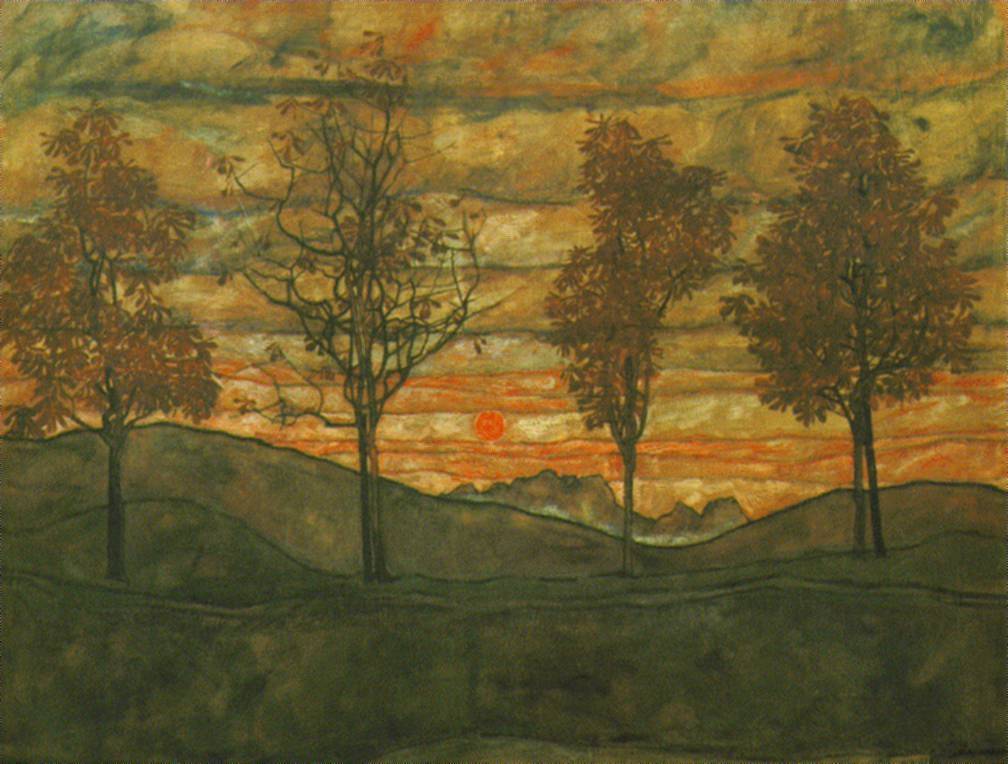
Conservation is a state of harmony between men and land. By land is meant all of the things on, over, or in the earth. Harmony with land is like harmony with a friend; you cannot cherish his right hand and chop off his left. That is to say, you cannot love game and hate predators; you cannot conserve the waters and waste the ranges; you cannot build the forest and mine the farm.

Four Trees, Osterriche Galerie

The land is one organism. Its parts, like our own parts, compete with each other and co-operate with each other. The competitions are as much a part of the inner workings as the co-operations. You can regulate them—cautiously—but not abolish them.

The outstanding scientific discovery of the twentieth century is not television, or radio, but rather the complexity of the land organism. Only those who know the most about it can appreciate how little we know about it. The last word in ignorance is the man who says of an animal or plant: "What good is it?" If the land mechanism as a whole is good, then every part is good, whether we understand it or not. If the biota (the plant and animal life of a region), in the course of aeons, has built something we like but do not understand, then who but a fool would discard seemingly useless parts? To keep every cog and wheel is the first precaution of intelligent tinkering.

Monday, October 09, 2006

2 Creation

Asking Better Questions: During the Creation Cycle, which questions might be reframed to help us better understand the problems and opportunities of sustainability in our interdependent world?

Bird of Prey, Jamie Morhaim

Contemporary Reading: Walking on the Wind by Michael Tlanusta Garrett (A native of Cherokee)

Asking the right questions, instead of asking for the right answers, allows us to know the function rather than the effect of our choices.

The following is a commonly posed question that reflects one’s outlook on life: “Is the glass half empty or half full?” This question presupposes that the answer can be only one of two possibilities. However, the Truth of Opposites, as I heard one elder put it, poses a different question altogether: “Is the glass the right size?” ...This is just one example of the way in which we limit ourselves through our perception of choice.

Monday, October 02, 2006

One Creation

Wendell Berry writes sacramentally about the cycle of life. We know the definition of a sacrament--an outward and visible sign of an inward and spiritual grace. In my experience we grasp the grace of the sacrament intuitively but only over time and with regular practice does a sacrament become transformational. Berry outlines a profound practice below. Is it really possible any longer to make it truly sacramental?


Contemporary
Reading: Wendell Berry, from The Gift of Good Land

We cannot live harmlessly or strictly at our own expense; we depend upon other creatures and survive by their deaths. To live, we must daily break the body and shed the blood of creation. The point is, when we do this knowingly, lovingly, skillfully, reverently it is a sacrament; when we do it ignorantly, greedily, clumsily, destructively, it is a desecration . . . in such desecration, we condemn ourselves to spiritual and moral loneliness, and others to want.

Tuesday, September 19, 2006

Seventeen Pentecost

Taken as a whole, the three readings this week invite us to consider a spirit of non-judgment and collaboration at the core of our tradition. How do we make more of it today?

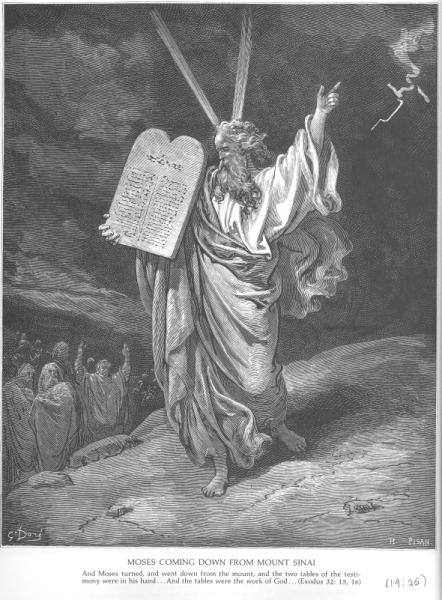
Moses Coming Down Sinai, Woodcut by Gustave Doré

Numbers 11:16.20

So the LORD said to Moses, "Gather for me seventy of the elders of Israel, whom you know to be the elders of the people and officers over them; bring them to the tent of meeting, and have them take their place there with you.

So Moses went out and told the people the words of the LORD; and he gathered seventy elders of the people, and placed them all around the tent. Then the LORD came down in the cloud and spoke to him, and took some of the spirit that was on him and put it on the seventy elders; and when the spirit rested upon them, they prophesied. But they did not do so again.

Two men remained in the camp, one named Eldad, and the other named Medad, and the spirit rested on them; they were among those registered, but they had not gone out to the tent, and so they prophesied in the camp. And a young man ran and told Moses, "Eldad and Medad are prophesying in the camp." And Joshua son of Nun, the assistant of Moses, one of his chosen men, said, "My lord Moses, stop them!" But Moses said to him, "Are you jealous for my sake? Would that all the LORD's people were prophets, and that the LORD would put his spirit on them!"

James 4:11-12

Do not speak evil against one another, brothers and sisters. Whoever speaks evil against another or judges another, speaks evil against the law and judges the law; but if you judge the law, you are not a doer of the law but a judge. There is one lawgiver and judge who is able to save and to destroy. So who, then, are you to judge your neighbor?

Mark 9:38-39

John said to Jesus, "Teacher, we saw someone casting out demons in your name, and we tried to stop him, because he was not following us." But Jesus said, "Do not stop him; for no one who does a deed of power in my name will be able soon afterward to speak evil of me. Whoever is not against us is for us.

Sunday, September 17, 2006

Sixteen Pentecost

What is greatness? Who comes in first? What is honor according to our deepest values?

Jesus and the Little Child, James Tissot


Mark 9:30-37

Jesus and his disciples went on from there and passed through Galilee. He did not want anyone to know it; for he was teaching his disciples, saying to them, "The Son of Man is to be betrayed into human hands, and they will kill him, and three days after being killed, he will rise again." But they did not understand what he was saying and were afraid to ask him.

Then they came to Capernaum; and when he was in the house he asked them, "What were you arguing about on the way?" But they were silent, for on the way they had argued with one another who was the greatest. He sat down, called the twelve, and said to them, "Whoever wants to be first must be last of all and servant of all." Then he took a little child and put it among them; and taking it in his arms, he said to them, "Whoever welcomes one such child in my name welcomes me, and whoever welcomes me welcomes not me but the one who sent me."

Sunday, September 10, 2006

Fifteen Pentecost

Take Up Your Cross. What does it mean in the day to day? Your average day to day?


Irish High Crosses

Mark 8:27-38

Jesus went on with his disciples to the villages of Caesarea Philippi; and on the way he asked his disciples, "Who do people say that I am?" And they answered him, "John the Baptist; and others, Elijah; and still others, one of the prophets." He asked them, "But who do you say that I am?" Peter answered him, "You are the Messiah." And he sternly ordered them not to tell anyone about him.

Then he began to teach them that the Son of Man must undergo great suffering, and be rejected by the elders, the chief priests, and the scribes, and be killed, and after three days rise again. He said all this quite openly. And Peter took him aside and began to rebuke him. But turning and looking at his disciples, he rebuked Peter and said, "Get behind me, Satan! For you are setting your mind not on divine things but on human things."

He called the crowd with his disciples, and said to them, "If any want to become my followers, let them deny themselves and take up their cross and follow me. For those who want to save their life will lose it, and those who lose their life for my sake, and for the sake of the gospel, will save it. For what will it profit them to gain the whole world and forfeit their life? Indeed, what can they give in return for their life? Those who are ashamed of me and of my words in this adulterous and sinful generation, of them the Son of Man will also be ashamed when he comes in the glory of his Father with the holy angels."

Tuesday, September 05, 2006

Fourteen Pentecost

Perhaps a good question for readers is always this, How can our ability to share what is most meaningful--inviting others into authentic community--be made more whole?


Carl Bloch: Christ Healing

Mark 7:31-37

Jesus returned from the region of Tyre, and went by way of Sidon towards the Sea of Galilee, in the region of the Decapolis. They brought to him a deaf man who had an impediment in his speech; and they begged him to lay his hand on him. He took him aside in private, away from the crowd, and put his fingers into his ears, and he spat and touched his tongue. Then looking up to heaven, he sighed and said to him, "Ephphatha," that is, "Be opened." And immediately his ears were opened, his tongue was released, and he spoke plainly. Then Jesus ordered them to tell no one; but the more he ordered them, the more zealously they proclaimed it. They were astounded beyond measure, saying, "He has done everything well; he even makes the deaf to hear and the mute to speak."


Monday, August 28, 2006

Thirteen Pentecost

Old rules, new realities. How do we reconcile the two? For a brief but detailed look at the issue of unwashed hands, see Marcus Borg.

Mark 7:1-8, 14-15, 21-23

Now when the Pharisees and some of the scribes who had come from Jerusalem gathered around Jesus, they noticed that some of his disciples were eating with defiled hands, that is, without washing them. (For the Pharisees, and all the Jews, do not eat unless they thoroughly wash their hands, thus observing the tradition of the elders; and they do not eat anything from the market unless they wash it; and there are also many other traditions that they observe, the washing of cups, pots, and bronze kettles.) So the Pharisees and the scribes asked him, "Why do your disciples not live according to the tradition of the elders, but eat with defiled hands?" He said to them, "Isaiah prophesied rightly about you hypocrites, as it is written,
    'This people honors me with their lips,
    but their hearts are far from me;
    in vain do they worship me,
    teaching human precepts as doctrines.'

You abandon the commandment of God and hold to human tradition."

Then he called the crowd again and said to them, "Listen to me, all of you, and understand: there is nothing outside a person that by going in can defile, but the things that come out are what defile. For it is from within, from the human heart, that evil intentions come: fornication, theft, murder, adultery, avarice, wickedness, deceit, licentiousness, envy, slander, pride, folly. All these evil things come from within, and they defile a person."

Monday, August 21, 2006

Twelve Pentecost

Will we find our way this week within John's seeming dualism: "The Spirit gives life, the flesh is useless?

Painting: Bread and Wine by Leonardo Da Vinci

John 6:60-69

Jesus said, "I am the bread which came down from heaven... the one who eats this bread will live forever." When many of his disciples heard this, they said, "This teaching is difficult; who can accept it?" But Jesus, being aware that his disciples were complaining about it, said to them, "Does this offend you? Then what if you were to see the Son of man ascending to where he was before? It is the spirit that gives life, the flesh is useless. The words that I have spoken to you are spirit and life. But among you there are some who do not believe." For Jesus knew from the first who were the ones that did not believe, and who was the one that would betray him. And he said, "For this reason I have told you that no one can come to me unless it is granted by the Father."

Because of this many of the disciples turned back and no longer went about with him. So Jesus asked the twelve, "Do you also wish to go away?" Simon Peter answered him, "Lord, to whom can we go? You have the words of eternal life. We have come to believe and know that you are the Holy One of God."

Monday, August 14, 2006

Eleven Pentecost

Out texts this week invite us to see Jesus in the context of Wisdom tradition. At the time of Jesus, Jewish theology thought of Wisdom (Sophia) as one who made manifest the ineffable God--and so laid essential ground work for a Christian understanding of the divine nature of Christ.

For a fuller account see Elizabeth Johnson.

Painting: Dina Cormick, Phoebe of Cenchrae


Proverbs 9:1-6
Wisdom has built her house,
she has hewn her seven pillars.
She has slaughtered her animals, she has mixed her wine,
she has also set her table.
She has sent out her servant girls, she calls
from the highest places in the town,
"You that are simple, turn in here!"
To those without sense she says,
"Come, eat of my bread
and drink of the wine I have mixed.
Lay aside immaturity, and live,
and walk in the way of insight."

John 6:53-59

Jesus said, "Very truly, I tell you, unless you eat the flesh of the Son of Man and drink his blood, you have no life in you. Those who eat my flesh and drink my blood have eternal life, and I will raise them up on the last day; for my flesh is true food and my blood is true drink. Those who eat my flesh and drink my blood abide in me, and I in them. Just as the living Father sent me, and I live because of the Father, so whoever eats me will live because of me. This is the bread that came down from heaven, not like that which your ancestors ate, and they died. But the one who eats this bread will live forever." He said these things while he was teaching in the synagogue at Capernaum.

Sunday, August 06, 2006

David's son Absalom has led the country into civil war against his father, and the following text concerns Absalom's end. Hard to know whether to focus on the tragedy of war or the brutal pain of a family's dysfunction.


David & Absalom
Marc Chagal


2 Samuel 18:5-9, 15, 31-33

The king, David, ordered Joab and Abishai and Ittai, saying, "Deal gently for my sake with the young man Absalom." And all the people heard when the king gave orders to all the commanders concerning Absalom. So the army went out into the field against Israel; and the battle was fought in the forest of Ephraim. The men of Israel were defeated there by the servants of David, and the slaughter there was great on that day, twenty thousand men. The battle spread over the face of all the country; and the forest claimed more victims that day than the sword. Absalom happened to meet the servants of David.

Absalom was riding on his mule, and the mule went under the thick branches of a great oak. His head caught fast in the oak, and he was left hanging between heaven and earth, while the mule that was under him went on.

And ten young men, Joab's armor-bearers, surrounded Absalom and struck him, and killed him.

Then the Cushite came; and the Cushite said, "Good tidings for my lord the king! For the LORD has vindicated you this day, delivering you from the power of all who rose up against you." The king said to the Cushite, "Is it well with the young man Absalom?" The Cushite answered, "May the enemies of my lord the king, and all who rise up to do you harm, be like that young man."

The king was deeply moved, and went up to the chamber over the gate, and wept; and as he went, he said, "O my son Absalom, my son, my son Absalom! Would I had died instead of you, O Absalom, my son, my son!"

Sunday Propers

You can see what all the lessons are here. Just go to the date at look at the RCL readings.

About Me